
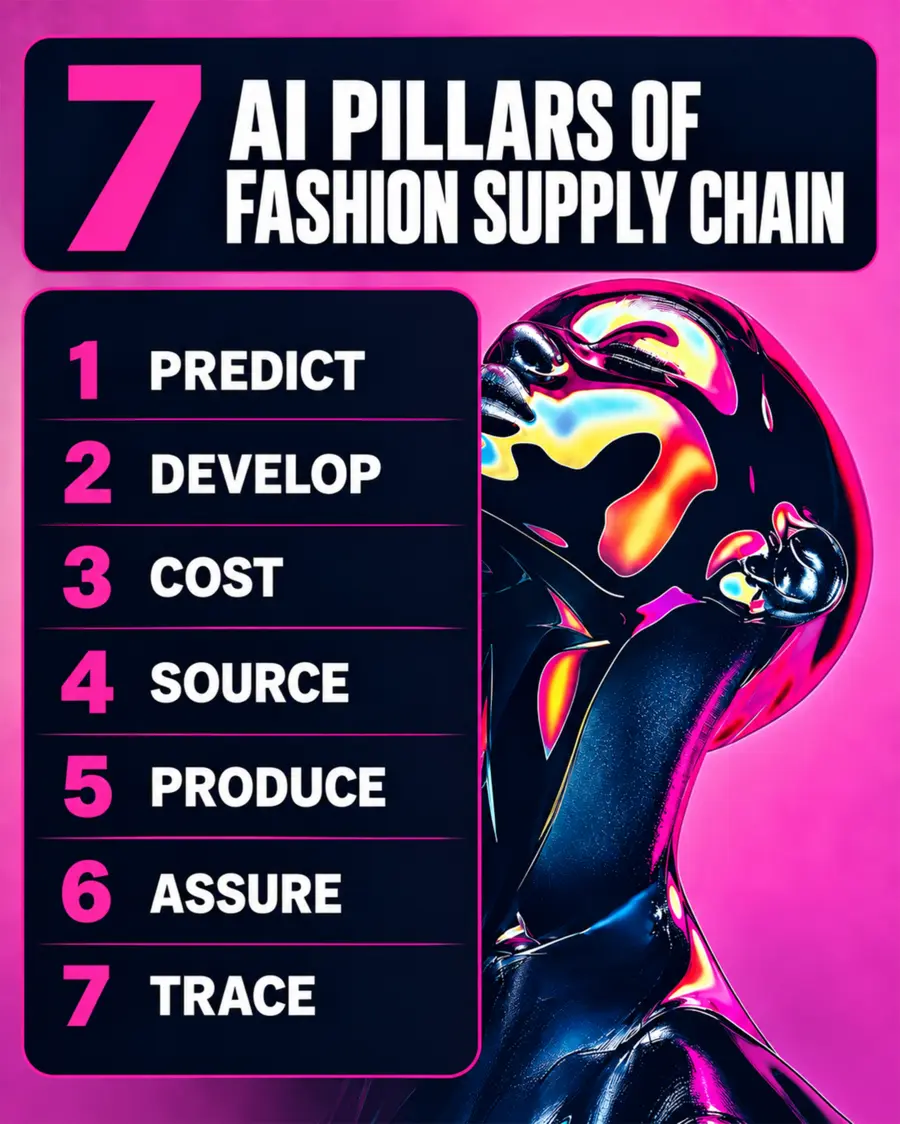
The 7 AI Pillars of Fashion Supply Chains
One message stood out to me across the sessions: AI is becoming part of more fashion conversations — design, marketing, sales — but how do we turn that interest into practical supply chain improvements? Better decisions need better information, and that's what this framework is built around.
1. Predict
Support demand forecasting, explore colours, quantities and repeat opportunities, and help buyers cross-check their own assumptions. Forecasts still need testing against real customer behaviour before volume is committed.
2. Develop
Explore product ideas, draft tech packs, and build clearer product briefs — giving experienced development teams more time to review and refine, rather than starting from a blank page.
3. Cost
Analyse garment costs, compare quotations, and flag unusual prices or missing items, then check the assumptions behind the numbers before a quote is accepted.
4. Source
Match products with suppliers using verified capability and performance records — fabric experience, wash expertise, MOQ, delivery history. Relationships still matter; evidence just makes those relationships easier to assess fairly.
5. Produce
Review order updates, flag potential delays, and highlight missing approvals, helping teams act before a small issue turns into a delivery problem.
6. Assure
Analyse inspection reports, identify recurring defects, and connect customer feedback with production problems, helping teams investigate the actual causes rather than just the symptoms.
7. Trace
Organise records from fibre to finished garment and flag missing documents, making product information easier to retrieve. AI can help manage traceability data — but it cannot create proof that was never collected in the first place, which for sustainable fashion wholesale is an essential distinction.
Start With Data Readiness
Every pillar above depends on records, so the first question is not "which AI tool?" but "what do we already know, and where is it kept?" Sales history in one system, quotes in email, approvals in chat and test reports in a folder mean any tool starts blind. A readiness check covers four things: are the records complete, are they consistent in naming and format, are they current, and can the right people reach them. Fixing those is slow and unglamorous, but it is where most of the value comes from.
Where to Begin: Picking One Pillar
Most teams should not start on all seven pillars at once. Choose the one where delays, errors or missing information cost you most today. A brand that regularly overstocks might start with Predict. One that struggles with late shipments might look at Produce. One with recurring defects might begin with Assure. Run a small pilot with a defined question, a fixed period and a measure of success, then decide whether to extend it. Pilots also show quickly whether your data is good enough.
Using AI for Costing and Quote Comparison
Costing is a practical example. A tool can compare quotations line by line, highlight a fabric price that looks out of range or a trim that has been left out, and flag a quote that differs from the last approved price. It cannot know that a supplier has quietly changed the fabric. Use it to ask better questions, then confirm the answers with the supplier. Our manufacturing cost guide and jeans costing sheet show how a cost is built up.
The Pillars Are Connected
These seven pillars aren't independent — poor information at one stage affects the next. A weak forecast can create excess stock. A poor supplier match can create quality problems. A missed warning can lead to late delivery. Missing records can weaken traceability. AI can help experienced people spot these patterns and investigate earlier, but the results depend entirely on the data feeding them, and on people actually acting on what they find.
Keeping People in the Loop
Each AI output should have a named person who reviews it and a rule for what happens when they disagree with it. Forecasts go to the buyer, quality flags to the quality manager, and supplier matches to sourcing. That keeps accountability clear and prevents decisions drifting to whichever number looks most confident. It also helps teams trust the tool, because they understand where it fits in the process.
Measuring Whether It Is Working
Pick a few measures before you start and record a baseline. Examples include forecast accuracy, number of sample rounds, quote variance, on-time delivery, defect rate at inspection and time spent searching for records. Compare after the pilot. If nothing improves, you have learned that cheaply, and if something does, you have the evidence to extend the work. Avoid measures that are easy to count but do not show a business benefit.
Questions to Ask Before Buying an AI Tool
Before you sign up for any platform, ask what data it needs and where that data is stored, whether you can export your records if you leave, how the tool explains its recommendations, how it was tested on apparel and what support is included. Ask for a pilot on your own data rather than a demonstration on someone else's. A tool that cannot explain its output, or that locks in your records, is a risk even if the demonstration looks polished.
What AI Does Not Change in Garment Making
AI can improve information, but a garment still has to be cut, sewn, washed and shipped by skilled people. Fabric behaves as it behaves, a machine breaks down, and a sample still has to be checked by hand. The brands that benefit most keep the practical disciplines, such as clear tech packs, sample plans and inspection, and add AI where it helps those disciplines work with better information. See our guides to tech packs and sampling.
What This Means for Buyers
For buyers, the potential benefits include faster decisions, better supplier matches, lower inventory exposure, fewer repeated quality problems, and clearer product records — and for sustainable fashion wholesale, these should be outcomes you actually measure, not just outcomes you assume. The key lesson from Texworld Paris was simple: start with the problem. Map your own seven pillars, find where delays, errors or missing information cost you most, then test one useful AI solution at a time, measure the result, keep what works, and improve what doesn't.
Risks and Limits to Plan For
AI introduces its own risks. Data confidentiality matters, since designs, prices and supplier terms are commercially sensitive. Models can reflect bias or gaps in their data, and fluent output can hide uncertainty. Regulation around data and automated decisions is evolving, so check current requirements for the markets you operate in. None of this is a reason to avoid the tools, but each is a reason to keep a person responsible, test outputs and document how decisions were made.
A 90-Day Pilot Plan
In the first month, choose one pillar and one question, gather the data it needs and set the baseline. In the second month, run the tool alongside your normal process and record where its output helped, where it was wrong and what people did about it. In the third month, review the measures, decide whether to continue, adjust or stop, and write down what you learned. For supplier matching in particular, see our AI factory selection guide, and for traceability data see sustainable sourcing strategy.
Connecting AI Outputs to Supplier Conversations
The best use of an AI flag is as the start of a conversation with a supplier, not as the end of one. A late-order alert should lead to a call about the cause, a cost variance should lead to a request for a breakdown, and a repeated defect should lead to a root-cause discussion. Suppliers who share timely, honest information make these conversations productive, which is one reason why transparent communication is such a useful criterion when choosing a manufacturer.
Training Your Team to Work With AI Output
Tools only help when people know how to question them. Teach the team to ask where a number came from, what data was used, how recent it is and what would make it wrong. Share examples of good and bad outputs, and agree a simple way to log errors so they can be corrected. Confidence grows when staff see the tool as an assistant that can be checked, not a black box that must be believed.
A Worked Example: Where the Pillars Meet in Practice
Take a single reorder decision as an example of how these pillars connect. A Predict tool flags that a jersey style is trending ahead of forecast. A Source record confirms which audited facility has spare capacity and prior experience with that fabric. A Cost check compares the reorder quote against the original approved price and flags a variance worth questioning. A Produce update tracks the order once it's placed, and an Assure record confirms the previous batch passed inspection with no recurring defects. None of these steps is complicated on its own — the value comes from having all seven connected, so a buyer isn't chasing five separate systems to make one reorder decision with confidence.
Where Ruhrose Fits
Ruhrose is UK-led and manufactures in Bangladesh through BSCI, WRAP, OEKO-TEX and GOTS-audited facilities. We use clear records, milestone updates and a style-specific sample plan to keep production visible, which is the kind of information any AI-supported process needs to be useful. If you want to compare how a supplier shares data and updates, read our guides to AQL inspection and choosing a clothing manufacturer.