
What a Sustainable Sourcing Strategy Actually Is
A sourcing strategy is a written set of decisions about what you buy, from whom, in what quantities, to what standard and with what back-up. It becomes a sustainable sourcing strategy when environmental and social criteria sit alongside price, quality and delivery in those decisions, rather than being added afterwards as a marketing line. In practice it usually covers four things: the materials and processes you will and will not accept, the evidence you require from suppliers, how you spread risk across more than one source, and how you review all of it over time. Without that structure, sustainability tends to depend on whoever happens to be buying that season.
Why the Old Sourcing Model Is Breaking
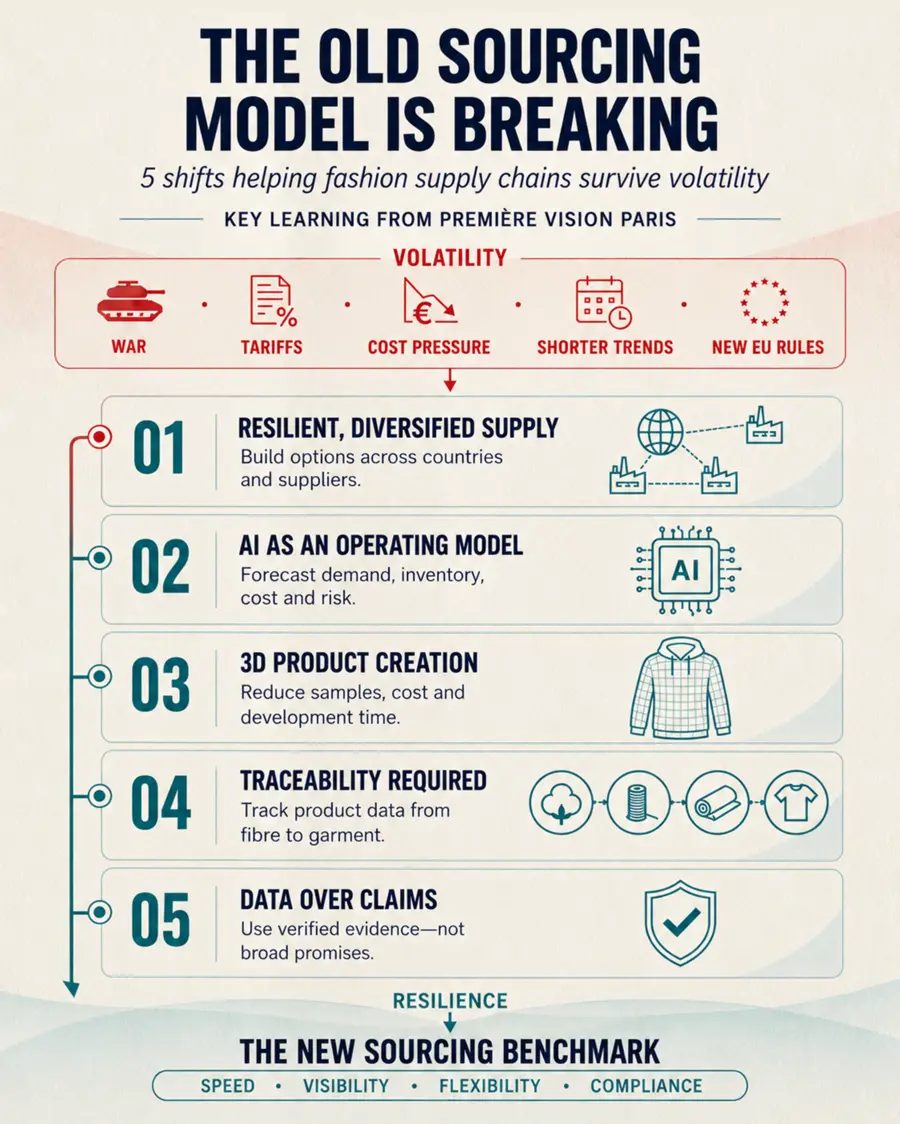
Trends move quickly, margins are under pressure, and buyers need more visibility into how products are made than a price-and-volume conversation can give them. For sustainable fashion wholesale specifically, the sourcing conversation needs to go beyond price and volume entirely. So what does the new sourcing model actually look like? Five pillars stood out to me from that session.
1. Resilient, diversified supply
Never depend completely on one country, supplier or shipping route. Build alternatives, and understand their capabilities before disruption happens rather than after. That thinking shapes our approach to production planning at Ruhrose.
2. AI as an operating model
Use AI to support forecasting, inventory planning, costing and early risk detection — but check the data, and question the output. Better tools still need good judgement behind them.
3. 3D product creation
Review designs digitally before making several physical samples. Reduce avoidable sampling rounds and make decisions earlier, then confirm fabric feel, washes and performance through physical testing once the concept is right.
4. Traceability
Know where the fibre, fabric and finished garment come from. Who made them? Where were they processed? What records support the information? For sustainable fashion wholesale, visibility needs to reach beyond the finished garment, through BSCI, WRAP, OEKO-TEX and GOTS-audited stages of production.
5. Data over claims
Saying a product is "sustainable" is no longer enough. Buyers need clear, verifiable evidence — material records, relevant certifications, measured process data, and clarity about what that evidence actually proves.
Map Your Supply Chain Beyond the Factory
Most brands know the name of the factory that sews their garments. Far fewer can name the fabric mill, the yarn spinner or the farm behind it. A practical first step is to map your supply chain in tiers. Tier one is the cut-and-sew factory. Tier two is the fabric mill and key trim suppliers, and tier three is yarn, fibre and dye houses. You do not need to map everything at once: start with your best-selling styles, record the supplier name and location at each tier, and note which documents you hold for each. Gaps in that map are where the risk, and the unverified claims, usually sit.
Supplier Criteria Worth Writing Down
Before you compare quotes, agree what a supplier must meet to be considered. A useful shortlist covers social compliance (a current audit such as BSCI or WRAP), chemical and product safety (for example OEKO-TEX testing), material certification where you make a fibre claim (such as GOTS for organic cotton), capacity and quality history, willingness to share records, and financial stability. Our guide to BSCI, SMETA and WRAP audits explains what each audit covers, and sustainable fabrics for clothing brands compares the main material options. Writing the criteria down once means every new supplier is judged the same way.
Certifications: What They Prove and What They Do Not
A certificate is evidence of something specific, and it pays to be precise about what. A social audit reports on conditions at a facility on the date it was assessed. An OEKO-TEX label relates to tested harmful-substance limits in the product. GOTS covers organic fibre content and the processing stages that follow, including social criteria. None of them, on their own, shows the whole garment is low-impact, and none replaces your own judgement. Ask for the certificate number, the scope and the validity dates, and check that the scope covers the actual site or product you are buying. Use certificates to support a claim, not to stand in for one.
Building Resilience Into the Strategy
Resilience is part of sustainability: a supply chain that fails every time a route closes pushes brands into rushed air freight and panic switches of supplier. Qualify at least one alternative for your most important styles, keep fabric specifications portable so a second factory can match them, and agree what triggers a switch. Our guide to building a backup supply chain sets this out step by step. Diversifying does not mean splitting every order across many factories, which can weaken your buying power; it means having a tested alternative ready.
How These Pillars Change a Sourcing Conversation
In practice, this shifts what a first meeting with a supplier should cover. Instead of opening with price per unit and minimum order quantity alone, a buyer working to these five pillars will ask where the fabric comes from, what happens if a primary shipping route is disrupted, what evidence sits behind any sustainability claim, and how quickly a design can move from concept to physical sample. None of that replaces a competitive price — it sits alongside it, and it's usually the difference between a supplier relationship that survives a disruption and one that doesn't.
It also changes how a sourcing team is structured internally. Diversified supply means someone has to actually own supplier relationships in more than one region, not just the cheapest one. Traceability means procurement and compliance need to be talking to each other regularly, not just at audit time. None of the five pillars work well in isolation — they depend on each other, which is part of why treating sourcing as a single price negotiation tends to break down under real-world pressure.
The Cost Question: Is Sustainable Sourcing More Expensive?
Sometimes the unit price is higher, because certified materials and audited factories carry real costs. But unit price is only one line. Fewer sampling rounds, fewer quality failures, less unsold stock and fewer emergency shipments all reduce total cost. Honest brands compare landed cost and risk, not just the price on the quote. Where a premium exists, decide whether you can absorb it, pass it on in pricing, or offset it through smaller, better-targeted ranges. See the manufacturing cost guide for how a garment price is built.
A 90-Day Plan to Put the Strategy in Place
In the first month, map tiers for your top five styles and collect the documents you already hold. In the second month, write your supplier criteria and ask current suppliers to confirm audits, certificates and fibre sources in writing. In the third month, shortlist one alternative supplier for your most important product, run a small sample or trial order, and set a review date. At the end of 90 days you will have a map, a standard and a back-up, which is a stronger position than most buyers start from.
Common Mistakes to Avoid
The usual errors are chasing certificates without checking scope, making sustainability claims the evidence cannot support, switching suppliers on price alone and losing the learning built up with a good one, treating audits as a once-a-year event, and leaving the strategy with one person. Regulation and buyer expectations in this area are also changing, so check current requirements for the markets you sell into rather than relying on last year's checklist. A modest strategy that is honestly applied beats an ambitious one nobody follows.
Putting It Together With Ruhrose
Ruhrose works from the UK and manufactures in Bangladesh through BSCI, WRAP, OEKO-TEX and GOTS-audited facilities, with programmes that start from around 500 pieces per style and colour so that you can test before you commit. If you are building a sourcing strategy and want to compare what a supplier can actually evidence, see our guides to sustainable wholesale clothing and choosing a clothing manufacturer, or contact us with your product and quantities.
What This Means for Sustainable Fashion Wholesale Buyers
The sourcing benchmark for sustainable fashion wholesale goes beyond the lowest price. It's about speed, visibility, flexibility, quality and compliance together. For buyers and sourcing managers, the practical question is simple: is your supply chain being redesigned for the world ahead, or still operating for the world that has already changed?