
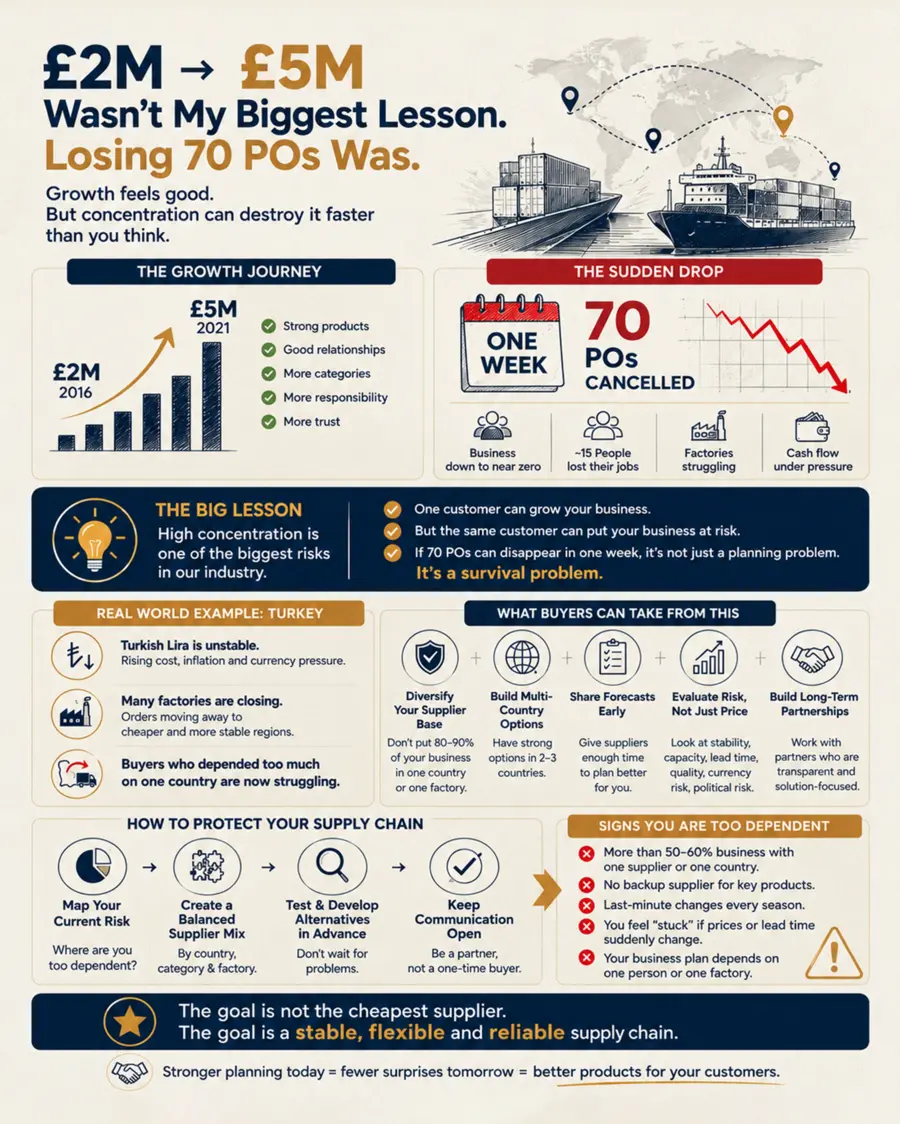
The Week 70 Purchase Orders Were Cancelled
Years of growth suddenly felt very small. Why did it happen? We were too dependent on one customer group. Concentration feels fantastic when everything is going well — until it isn't. And the same lesson applies directly to buyers sourcing their own supply chain: one factory, one country, one sourcing region can be efficient, and it can also become a huge risk.
Where Supply Chain Risk Actually Comes From
Risk in clothing sourcing rarely comes from one place. Customer concentration is the one described above, but buyers face others too: supplier concentration, where one factory makes most of your range; geographic concentration, where one country or region carries the exposure; material concentration, where a single mill supplies your key fabric; logistics risk, from port delays, route closures and rising freight; and financial risk, from currency swings and payment terms. A backup plan works best when it considers each of these, not only the factory name on the purchase order.
How to Tell Whether You Are Too Dependent
A few questions give a quick picture. What share of your volume comes from your largest supplier? Could another factory make your best-selling style from your tech pack within a reasonable time? Do you know who supplies the fabric behind it? If your main supplier stopped taking orders next month, how many weeks of stock would you have? Is there anyone else you have already tested? If the answers are uncomfortable, you have a dependency worth addressing. There is no universal safe percentage, since it depends on your size and product, but a single source for everything is rarely comfortable.
Think Beyond Finding Your Next Supplier
For buyers searching for ethical clothing manufacturers UK, think beyond just finding your next supplier — think about building an alternative before you actually need one. Currency pressure, rising costs, shipping delays and capacity changes can shift surprisingly fast, so don't wait for a crisis to find your Plan B.
Primary and Secondary Supplier Roles
A backup supplier does not need to be treated as a copy of your main one. Many brands give the secondary supplier a smaller, steady share of volume, perhaps a few styles or a proportion of repeat orders, so that the relationship stays active and the factory is familiar with your standards. This is purely illustrative, since the right balance depends on prices, minimums and capacity, but a supplier who regularly receives your orders is far more likely to find capacity for you in a crisis than one you have not spoken to for a year.
Make Your Product Portable
The quickest way to switch factories is to make your product easy to move. Keep a complete tech pack, current pattern files, graded size charts, approved sample records, fabric and trim specifications with supplier details, and wash recipes or artwork files. If your know-how lives in one factory's heads, a switch means starting again. Own your documents, store them somewhere secure, and update them whenever an approved change is made.
Building an Alternative While Plan A Is Still Working
Develop alternative suppliers while Plan A is still working well. Test them with small orders, understand their capability, and keep the relationship warm even when you don't need it yet. When comparing results for ethical clothing manufacturers UK, ask practical questions: where are the garments made? How are working conditions checked? Can they meet your quality and delivery requirements? And does their production depend on the same factories or shipping routes as your existing supplier?
The Hidden Shared Dependencies
Two factories can look independent and still rely on the same fabric mill, the same port or the same subcontractor. Ask each supplier where the fabric and trims come from, who does any outsourced processes such as washing or printing, and which port and carrier they normally use. If both depend on the same mill, a fabric shortage will hit both at once. Real diversification means separating the points of failure, not just the signatures on the contract.
Choosing the Region for Your Second Source
A second supplier in the same country can protect you against a single factory failing, while one in a different country can protect you against national or regional disruption, at the price of different lead times, duties and customs. Compare the options with our guides to Bangladesh versus China, Bangladesh, Pakistan and India for jeans and importing clothing from Bangladesh to the UK. Pick the region that fits your products and risk, not simply the cheapest.
A Different Supplier Name Doesn't Always Mean a Different Risk
This is the part buyers most often miss. A small test order helps you learn how a potential backup supplier communicates, how they solve problems, and how closely their bulk production matches an approved sample — then you check their capacity to scale if you ever need to lean on them properly. Searching for ethical clothing manufacturers UK is only a starting point; a tested relationship is what actually makes a backup useful when you need it.
What to Measure in a Backup Trial
A trial order is worth most when you measure it. Compare the backup against your main supplier on sample accuracy at first submission, communication speed and clarity, how problems were handled, on-time delivery, quality results at inspection, and how closely bulk matched the approved sample. Record the results in a simple table so the decision is not made on memory. Our guides to AQL inspection and the manufacturer vetting checklist give a framework for those comparisons.
A Practical Checklist for Testing an Alternative Supplier
Building a backup doesn't need to mean a second full-scale sourcing project. A workable starting point is a short checklist: place one small, low-risk order — a repeat style you already know well, not your most complex development — so you're testing the supplier, not the product. Confirm certifications and audit scope for the specific facility, not the group. Ask directly how they'd handle a sudden volume increase if your main supplier became unavailable for a season. And keep the relationship active with occasional small orders even when you don't strictly need the capacity, so the moment you do need it, it isn't a cold start.
The Real Cost of Holding Two Suppliers
A backup has a cost, and it is better to see it plainly. You may pay more per unit on smaller orders, carry extra sampling and management time, and manage another set of minimums. Set that against the cost of a stalled season: missed launches, cancelled customer orders and rushed freight. For many brands, a modest ongoing cost is a reasonable insurance price. Use our MOQ guide to understand what a second source will require.
A Simple Contingency Playbook
Write down what you will do if your main supplier cannot deliver. Define the triggers, such as a delay over a set number of weeks, a failed audit or a quality failure, and who decides. List the styles to move first, where the fabric will come from, what approvals the backup needs, and how customers will be informed. A one-page playbook turns a stressful moment into a sequence of steps, and it can be reviewed once or twice a year as the business changes.
Cash Flow and Payment Terms With a Second Supplier
A new supplier will often want stricter payment terms at first, such as a larger deposit, until trust is built. Plan for that in your cash flow so the trial does not strain your finances. Our payment terms guide explains the usual structures. As the relationship develops, you can negotiate terms that reflect a track record, in the same way you did with your main supplier.
Reviewing Your Backup Plan Regularly
A backup plan goes out of date quietly. Suppliers change ownership, factories lose certifications and your own range evolves. Put a review in the calendar once or twice a year: confirm audits and contact details, check that the backup can still make your current best sellers, and place a small repeat order if it has been quiet for too long. A plan that is tested regularly will work when you need it.
The Best Time to Build a Backup Supply Chain
Because the best time to build a backup supply chain is when you don't need one. That was one of the most expensive lessons of my career — and probably one of the most valuable. It's part of why Ruhrose's development and production process is built to support smaller, lower-risk test orders for buyers who want to build a second, proven supplier relationship without disrupting their main one.