
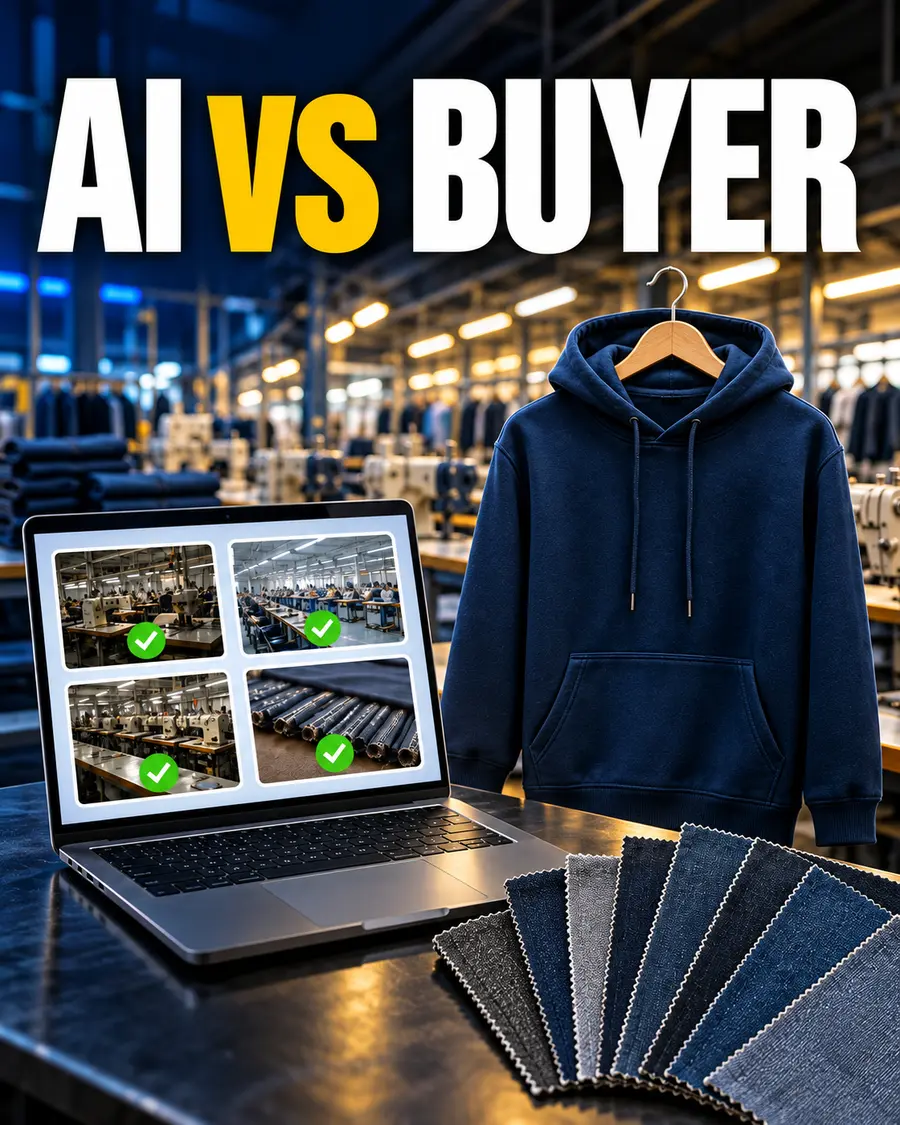
A Good Factory Isn't Automatically the Right Factory
Imagine a new denim programme: 12-ounce comfort stretch, vintage mid-blue wash, laser finishing, a requirement for measured lower-impact washing, 500 pieces per wash initially, a target FOB around $20, samples needed in roughly two weeks, and larger repeat orders if the product sells. You have 38 factories in your database — which one do you choose?
Most sourcing people already have three or four names in mind. But are those the strongest suppliers for this specific brief, or simply the suppliers they know best? For buyers comparing sustainable denim suppliers, that distinction matters. A good factory isn't automatically the right factory: one supplier might be excellent at large denim programmes but struggle with 500 pieces per wash; another might produce beautiful samples but need five development rounds to get there; another might offer the lowest FOB but miss delivery and leave you paying for air freight.
What AI Can and Cannot Do in Supplier Selection
AI is useful where there is a lot of information to sort and compare. It can search a large supplier list against a brief, flag gaps in records, summarise audit reports, draft questions for a shortlist and highlight unusual patterns in sample or delivery history. It cannot see a factory floor, judge honesty, or know facts that nobody has recorded. Its output is only as good as the data it is given, which is why the rest of this guide spends so much time on the database before the model.
Writing a Brief an AI Tool Can Use
A vague request returns a vague answer. Write the brief the way you would for a human buyer: product type and construction, fabric and weight, finishing or wash, quantity per style and colour, target price and incoterm, sample deadline, expected reorder volume, compliance requirements and any non-negotiables. The denim example at the start of this guide shows what a complete brief looks like. Keep one standard format so that every programme is compared in the same way, and keep sensitive documents such as tech packs out of any tool whose data handling you have not checked.
What a Useful Supplier Database Should Record
The question is bigger than "who can make denim?" It's "who can deliver this product, at this quantity, within this budget and timeline?" This is where AI can genuinely help — if the supplier database records more than names and contact details: product specialisation, fabric experience, wash capabilities, machinery, MOQ, actual sampling lead times, sample approval rates, quality problems, delivery performance, comparable prices, verified compliance records, and available capacity. Give AI your product brief against that data and ask it to identify the strongest matches, with the evidence behind each recommendation. But missing information must stay visible — an unknown capability should never quietly become an assumed strength.
Data Quality: The Part Most Teams Skip
Before an AI tool can rank anyone, someone has to make the data trustworthy. Check that each supplier record has a date, a source and a name of the person who verified it. Distinguish between what the supplier told you, what you observed in a visit or sample, and what a third party certified. Remove duplicates, fix outdated minimums and mark records that have not been reviewed recently. A smaller database that is accurate and current will give better answers than a large one nobody maintains.
Comparing Three Factories Against One Brief
Factory A has excellent washing equipment and strong laser capability, but its efficient MOQ is 5,000 pieces per wash — your trial needs 500. Factory B accepts the quantity and the price looks good, but previous developments took four or five sample rounds. Factory C costs slightly more, has handled similar fabrics and washes, accepts your starting quantity, and has a stronger record of sampling and delivery. Factory C may be the better match — though before confirming, you'd still need to check current capacity, pricing and production arrangements. The biggest factory doesn't automatically win. Neither does the cheapest. The evidence should guide the shortlist.
A Worked Example of Weighted Scoring
To show the idea, imagine weights applied to the six areas for the 500-piece denim programme above. This is a purely hypothetical example, not a real supplier comparison. A buyer might give MOQ flexibility and sampling reliability higher weight because the first order is small and the deadline is tight, and give capacity at scale a moderate weight because that matters only if the product sells. Each factory is then scored against each area from the evidence in the database, the scores are multiplied by the weights, and the totals are compared. The result is a conversation starter rather than a verdict, and the buyer should be able to explain every score.
Compliance as a Gate, Not a Score
Social and environmental compliance should be tested before scoring begins. If a factory does not hold a current, in-scope audit or the certification your customers require, it should not appear in the ranking at all. Check the facility name, scope and expiry date, not only that a certificate exists. Our guides to BSCI, SMETA and WRAP audits and denim certifications explain what to look for.
Building a Factory Fit Score
I'd compare suppliers across six practical areas: product capability, technical capability, capacity and scalability, MOQ flexibility, speed and reliability, and total commercial cost. Set the weighting around the specific programme — a repeat basic and a complicated washed jean shouldn't necessarily use the same priorities. Required compliance should be a gate, not a trade-off: a low price shouldn't compensate for failing a mandatory standard. For sustainable denim suppliers specifically, check traceability, chemical management and the evidence behind environmental claims — owning a laser machine alone doesn't prove lower environmental impact. You need to understand the actual process, and what has genuinely been measured.
Turning a Shortlist Into a Decision
Once AI and scoring have produced a shortlist of two or three factories, move to verification. Send the same brief to each and compare their written responses. Request samples or a development trial. Review their audit documents, and if possible visit or arrange a virtual walk-through using the questions in our factory visit checklist and the manufacturer vetting checklist. Pay attention to how each supplier handles questions and problems, since that predicts how they will behave when production is under pressure.
Risks to Manage When Using AI for Sourcing
Four risks come up repeatedly. Confidentiality: designs and costings are valuable, so check where a tool stores and uses what you upload. Bias: a model that favours well-documented suppliers may overlook smaller, capable factories with weaker online presence. Over-confidence: a fluent answer can sound more certain than the evidence allows. Dependence: if the team stops asking questions, errors in the data go unnoticed. Treat AI output as a draft to be tested, and keep a person accountable for each decision.
A Six-Step Workflow You Can Start With
First, clean and date your supplier records. Second, write a structured brief for the programme. Third, set compliance gates. Fourth, use AI to compare the remaining suppliers and draft questions. Fifth, verify the top two or three through samples, documents and conversation. Sixth, place a small test order and record the result in the database so the next search starts with better evidence. Our guide to testing and scaling a new style explains how to use that first order.
Common Mistakes When Using AI to Pick a Factory
Typical errors include feeding the tool incomplete or outdated records, writing a brief that omits the real constraints, treating a ranking as a recommendation, skipping verification because the score looks convincing, and forgetting to feed results back into the database after the first order. The remedy is simple discipline: clean data, a full brief, human checks, and a written record of what happened.
Why AI Still Needs Human Judgement
A factory profile can look excellent on paper: good machinery, competitive prices, impressive certificates. Then you visit, and the sample room is disorganised, production lines are already full, subcontracting isn't clearly explained, or management promises everything without asking enough questions. Those signals matter — and so does what happens when something goes wrong. Does the supplier tell you immediately, explain the cause, and bring practical solutions? You learn that through visits, development and real orders, not through a database alone.
AI can organise evidence, but it can also repeat errors or bias in the information it receives. A confident recommendation isn't proof. Before investing in an AI sourcing platform, ask what you actually know about your suppliers, what you can prove, whether profiles are kept current, and whether certification scope and validity are checked. Bad data plus AI is still bad sourcing. The strongest combination is AI and experience: use AI to compare records, spot gaps and prepare questions, and use experienced people to verify capability, assess relationships and make the final decision.