
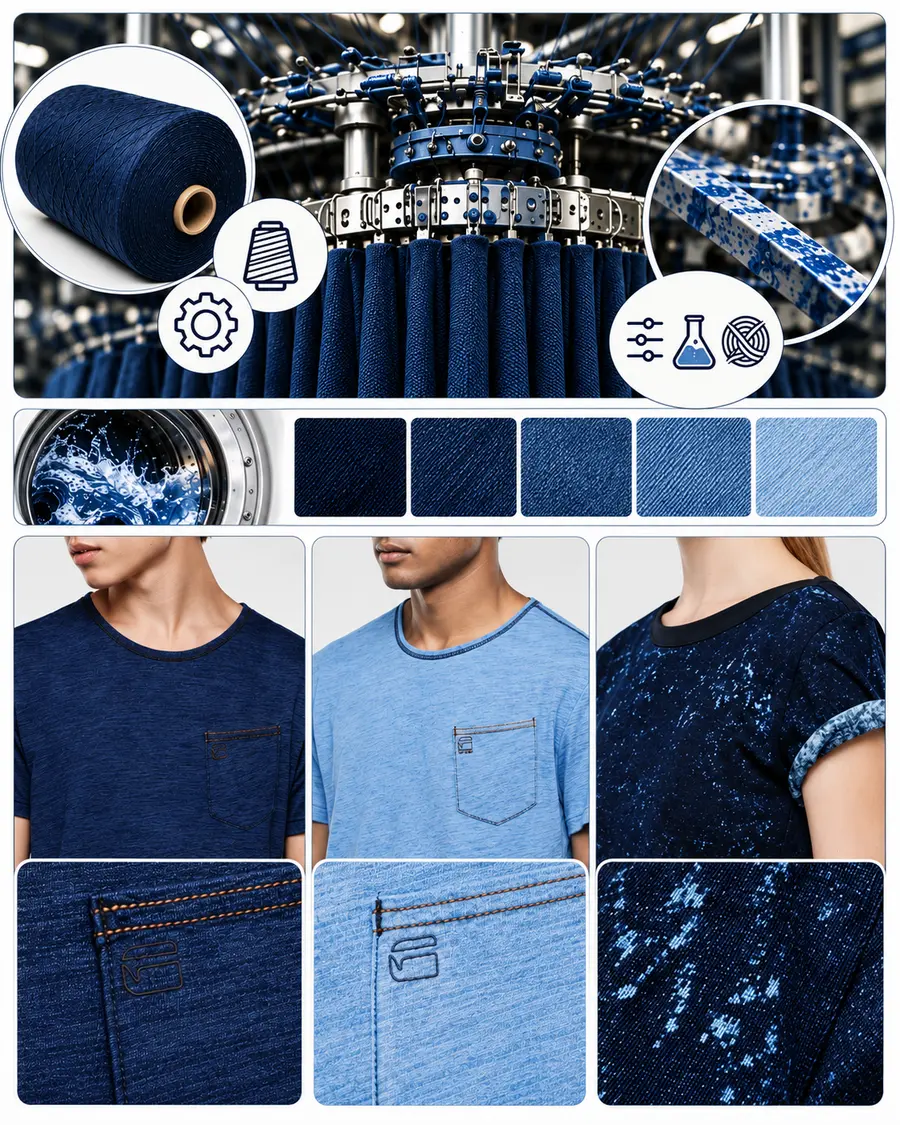
An Unusual Idea: Indigo Yarn, Knitted Into Jersey
We started with Epyllion in Bangladesh, working closely with their knitting, dyeing and finishing teams. Mr. Saeed, then GM of the fabric unit, was heavily involved from early on. The first challenge was the yarn itself: a yarn designed for weaving doesn't automatically run well through a knitting machine. Different tension, different movement, different demands on the fibre. So we worked with Envoy to develop an indigo yarn suitable for knitting specifically.
For buyers comparing sustainable denim suppliers, this is a useful reminder: understanding indigo means understanding more than just the final wash. The yarn and the construction matter just as much, and that development mindset has stayed with us at Ruhrose ever since.
Why Indigo Behaves Differently in Knit and Woven Fabric
Indigo is a surface dye. It sits mostly on the outside of the yarn rather than penetrating to the core, which is why jeans fade so characteristically. In woven denim, the warp yarns are dyed and then held tightly in the fabric. In knitting, the yarn is repeatedly bent into loops under tension and passes over needles and guides, so the same surface dye rubs off far more readily. This is why a machine can turn blue, and it explains why a knitting yarn needs different preparation from a weaving yarn.
When the Knitting Machine Turned Blue
Then came the moment I still remember clearly. We put the yarn on the knitting machine, and the machine started turning blue — indigo was rubbing off the yarn and depositing onto the machine as it ran. An exciting idea had suddenly become a real manufacturing problem.
What Can Be Adjusted on the Knitting Side
When dye rubs off during knitting, the options fall into a few groups. The yarn can be treated or finished differently to reduce loose dye. Yarn tension and feed can be adjusted to lower friction. Machine settings, needle and guide condition and speed can be changed, and the knitting environment can be cleaned more often. Each change has a side effect on fabric appearance, hand-feel or output, so development usually proceeds through repeated small trials, as described below, rather than a single fix.
Solving It With Epyllion's Knitting, Dyeing and Finishing Teams
I spent days and nights with Epyllion's knitting, dyeing and finishing managers. We experimented, adjusted yarn tension, worked on the yarn itself, changed machine settings, knitted again, washed, tested, failed, adjusted, and tried again. When assessing sustainable denim suppliers, ask how they actually handle difficult developments like this one: can they explain the problem clearly? Bring the right technical people together? Test solutions properly rather than guessing? A supplier's response to failure tells you something a sales presentation never can.
Denim-Look Jersey: What You Can Make From It
A denim-character jersey suits many products: T-shirts, sweatshirts, hoodies, shorts, joggers and lightweight jackets. Because it is a knit, it is more comfortable and stretchy than woven denim and avoids some of the fit problems of rigid fabric, while keeping the faded, worn look customers associate with indigo. It sits well alongside a jeans range as a coordinating piece. For a general overview of jersey weights and types, see our jersey wholesale buying guide.
Washing and Finishing an Indigo Jersey
The techniques borrowed from denim apply to jersey, but need adapting. Knits are lighter, more stretchy and more prone to distortion, so aggressive mechanical washes can damage shape. Lighter enzyme or softening washes, controlled fading, bleaching and tinting can produce a range of shades, from deep indigo to pale sky. Always approve a wash on a finished garment, and keep the recipe on record so repeats match. Our guides to denim washes and laser and ozone finishing explain the wider options.
What a Denim-Character Jersey Fabric Opened Up
Eventually, we started getting what we wanted: a jersey fabric with the character of denim. And that opened another door — because the yarn was indigo dyed, we could experiment with techniques normally associated with jeans on T-shirts, sweatshirts and other jersey garments. Different washes, fades, bleaching effects, different shades of indigo. A technical problem had become a genuine new product playground, and the development eventually became part of a successful G-Star indigo jersey and sweats programme.
Testing an Indigo Knit Before Bulk
Indigo jersey needs rigorous testing because loose dye can transfer to skin, other garments and furniture. Check colour fastness to rubbing (crocking) wet and dry, colour fastness to washing, shrinkage, spirality (where side seams twist after washing), pilling and seam strength. Test on the washed garment, not only on raw fabric. Read our guides to crocking and garment testing for what to request.
Care Labels and Customer Expectations
Customers expect indigo garments to fade, but they do not expect them to stain other clothes. Tell them honestly how the garment will behave, recommend washing it separately, in cool water and inside out for the first washes, and put this on the care label and product page. Setting expectations clearly reduces complaints and returns and supports a brand's reputation for transparency. Check our denim care label guide for suggested wording.
Innovation Alone Doesn't Prove Sustainability
But innovation alone doesn't prove sustainability. When comparing sustainable denim suppliers, technical creativity should sit alongside traceability and evidence about the processes actually used. Both deserve proper questions before you commit a programme to a new fabric idea.
How to Brief a Supplier for an Indigo Jersey Development
A clear brief shortens development. State the target look with reference images, the fabric weight and composition, the shade range and the products you plan to make. Specify the testing requirements, the quantity you expect to order and the date you need samples. Ask the supplier how they will manage the knitting and dyeing risks, which technical people will be involved, and how many trials they expect. Agree in advance who pays for development and what happens if the fabric cannot be made to the standard you need. See our sampling guide for how to run the rounds.
Timeline and Minimums for a New Knit Fabric
Developing a new fabric takes longer than ordering an existing one. Yarn development, knitting trials, dyeing or washing tests and approvals can each add time, and failures are part of the process. Fabric minimums also apply, since a mill will need a viable quantity to run. Ask your supplier for realistic ranges for both, rather than a promise, and build them into your launch plan using our lead times guide.
Sustainability Questions for Indigo and Wash Processes
Indigo dyeing and washing both use water, energy and chemicals, so ask suppliers how they manage them. Relevant questions cover the dye type and its handling, effluent treatment, the wash method and whether lower-water options such as ozone or laser are used, and what records they can show. Request documents instead of relying on descriptions. Our guides to water use in denim production and indigo dyeing explain what to look for.
Is Indigo Jersey Right for Your Range?
A denim-look knit suits brands that already sell denim or casual wear and want a softer, more comfortable companion. It is less suitable where customers expect colourfast garments or where the price point cannot absorb development and testing costs. Start with a small test run in one or two styles, gather customer feedback on feel and fading, and scale what sells. Our guide to testing and scaling a new style explains how to do that.
Product Ideas for Denim-Look Knits
Once a dependable indigo knit exists, product options broaden. Consider a relaxed hoodie with a faded wash, a boxy T-shirt in deep indigo, a drawstring short, a knit trouser that reads as denim but feels like sweatwear, or a lightweight overshirt. Pair the range with woven denim so customers can build a full outfit. See our custom hoodie guide for how hoodie programmes are specified.
Questions to Ask Before You Order Bulk
Before committing to bulk, confirm that the approved fabric and wash can be repeated, what colourfastness and shrinkage results were achieved on the final fabric, what the fabric minimum and lead time are, and what happens to fabric left after the order. Ask for a pre-production sample from bulk fabric and compare it with the approved development sample. A repeatable fabric is worth more than an impressive one-off.
What This Means for Buyers Developing Denim-Inspired Jersey Today
The same principle applies well beyond one factory in 2013. Any development that borrows a technique from one category and applies it to another — indigo dyeing moved from weaving to knitting, a wash process moved from denim to jersey, a finish developed for one fabric weight applied to another — carries the same risk of an unexpected failure mode. The lesson isn't to avoid ambitious development; it's to build in the testing time and the right technical partners before committing to a delivery date. A supplier who pads a development timeline to allow for genuine trial and error is usually more reliable than one who promises a fast turnaround on something neither side has actually made before.
The biggest lesson I took from that project wasn't the final garment — it was this: real product innovation rarely starts with knowing exactly how to make something. Sometimes it starts with an idea that doesn't work. Then a machine turns blue. And that's when the real product development actually begins.